Article: What 1.00ct really looks like: oval, round and cushion on the hand
What 1.00ct really looks like: oval, round and cushion on the hand
A 1.00ct round brilliant diamond measures about 6.4 to 6.5mm across. A 1.00ct oval is roughly 7.5 to 7.7mm long by 5.5 to 5.7mm wide. A 1.00ct cushion is about 5.5 to 6mm square. Same weight, three different sizes on the hand, because carat is weight, not width. This article gives the honest millimetre sizes for each shape, explains why the oval looks the largest, and shows how to judge the size against your own finger before you buy.
Carat is weight; millimetres are what you see
A carat is a fifth of a gram. What you see on the hand is the top of the stone, the face-up area, and the two are related but not the same. Two stones of identical weight can face up differently depending on their shape and how deeply they are cut. A deep stone hides weight below the girdle where nobody sees it. A shallow one spreads it across the top.
This is why the question of how big 1.00ct is cannot be answered with a single number. It has to be answered by shape.
1.00ct by shape, in millimetres
These are typical measurements for well-cut stones. Individual diamonds vary by a few tenths of a millimetre either way.
- Round brilliant: about 6.4 to 6.5mm in diameter.
- Oval: about 7.5 to 7.7mm long by 5.5 to 5.7mm wide, depending on how elongated the outline is.
- Cushion: about 5.5 to 6mm square, or slightly longer if it is a rectangular cushion.
- Emerald cut: about 6.5 to 7mm long by 4.5 to 5mm wide.
- Pear: about 7.7 to 8mm long by 5.5mm wide at the widest point.
- Princess: about 5.5mm square.
Every one of those stones weighs the same. Laid out on a bench they do not look it.
Why the oval looks bigger
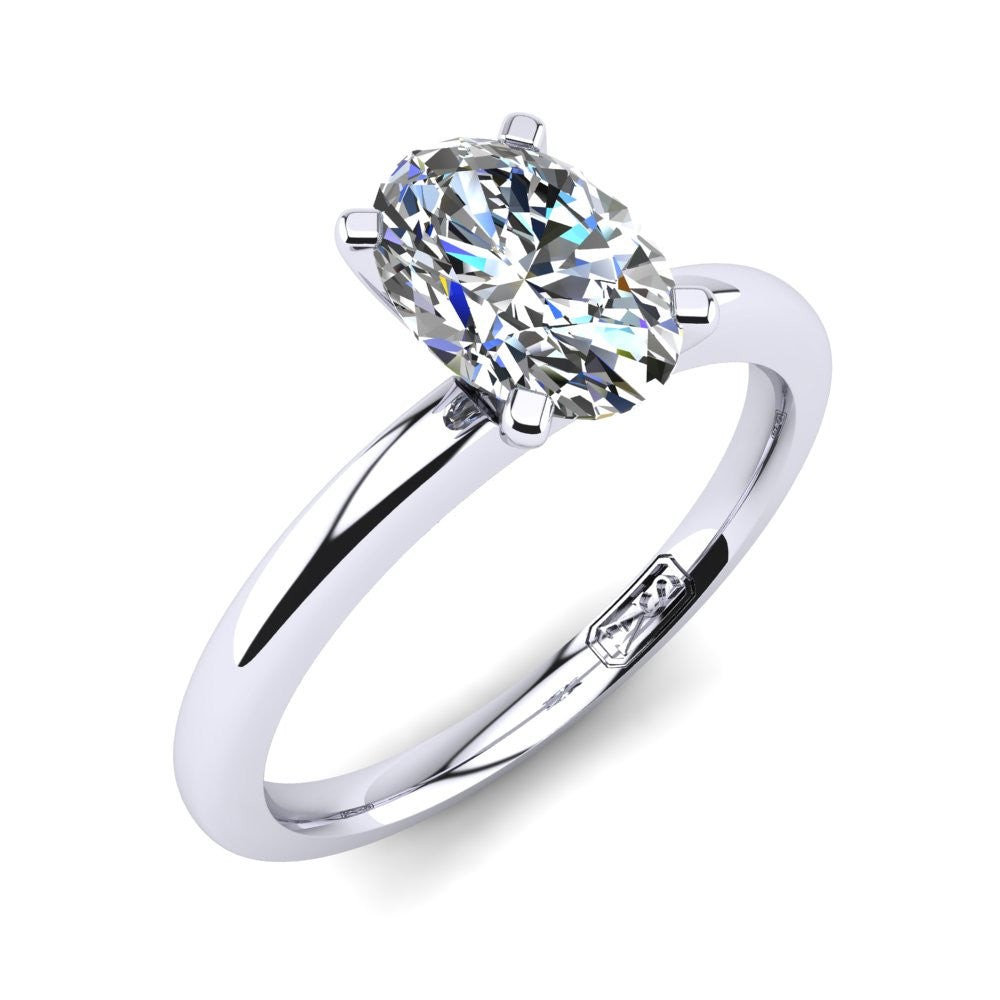
Face-up area for a 1.00ct oval is only marginally more than for a 1.00ct round. The difference is the outline. A 7.7mm length runs along the finger, and length is what the eye reads as size. The oval also lengthens the look of the finger, which is a large part of why it has become the most requested shape after the round. It is not a trick; it is simply that an elongated shape spends its area where you notice it.
The pear does the same thing, with a point that draws the eye further along the finger. The emerald cut is narrower again, and its step facets show broad flashes rather than sparkle, so it reads as elegant rather than large.
Why the cushion looks smaller
A cushion is cut deep. A good deal of its weight sits in the pavilion, which gives it the soft, pillowy light that people love, but it means a 1.00ct cushion faces up at 5.5 to 6mm, visibly smaller than a round of the same weight. The princess has the same characteristic. If you love the cushion but want the presence of a 1.00ct round, look at a 1.20 to 1.30ct cushion, or consider the lab-grown route below.
The halo effect
A halo, the ring of small diamonds around the centre stone, adds roughly 1.5 to 2mm to the overall face-up size. A 0.75ct round with a halo can present as a 1.00ct to 1.20ct stone from a normal viewing distance. This is the most cost-effective way to add size to a natural diamond ring, and our halo designs such as Jenna, Skye, Flora and Emma are built around it. The trade-off is that a halo is a busier look, and a solitaire on a plain band will always show the centre stone more honestly.
Finger size changes everything
The same 6.5mm round covers a different proportion of a size J finger than a size P finger. On a slender finger, around 16mm across, a 1.00ct round spans about 40 per cent of the width and looks generous. On a larger finger it looks more modest, and a 1.20ct or 1.50ct stone may be what reads as one carat to you. Bring your own hand to the decision, not a photograph of somebody else's.
Band width plays a part too. A slim 1.8 to 2mm band makes the stone look larger; a 3mm band makes it look more settled. Our tapered designs narrow the band at the shoulders for exactly this reason.
Drawn to scale on every product page
Because photographs of rings are almost always enlarged, every engagement ring on our site carries a section headed Your stone, drawn to scale. It draws the centre stone at its true millimetre size on an average finger, changes when you change the carat option, and states the width in millimetres beside it. It exists so that the size you see is the size you get. Use it, and then come and put a real stone on your hand, because the diagram is honest but a finger is better.
Lab-grown changes the arithmetic
If a 1.00ct natural diamond is at the edge of your budget, a lab-grown diamond of 1.50ct or 2.00ct will often cost less. In our lab-grown engagement collection, most designs run from 1.00ct to 3.00ct, IGI certified. A 1.50ct lab-grown oval is about 8.5 by 6.3mm; a 2.00ct is about 9.5 by 7mm. The carat sizes on this page apply identically to lab-grown stones, because a lab-grown diamond is a diamond, cut the same way.
Where to look by shape
Each shape has its own collection, with natural and lab-grown options side by side:
- Round brilliant and lab-grown round
- Oval and lab-grown oval
- Cushion and lab-grown cushion
- Emerald, pear and princess
If you are still choosing between shapes, our guide to diamond shapes for engagement rings covers how each one cuts light, and our custom engagement ring service lets you set any of them in a design drawn for you.
Book a private viewing at our King William Street boutique and see a 1.00ct round, oval and cushion side by side on your own hand: choose a time here.