Article: How to Choose a Wedding Band That Pairs With Your Engagement Ring (Adelaide Guide)

How to Choose a Wedding Band That Pairs With Your Engagement Ring (Adelaide Guide)
The short answer
The wedding band you slip on at the altar will sit beside your engagement ring every day for the rest of your life. Choosing one that complements the engagement ring — rather than competing with it — comes down to five decisions: profile, metal, width, finish, and whether you want diamonds. Get those right and the two rings read as one piece of jewellery, not two. This guide walks you through each decision the way we'd walk a couple through it in our Adelaide boutique, with real examples from the wedding band styles we make most often.
Start with the profile of your engagement ring
Before you look at a single wedding band, take a close look at the side profile of your engagement ring. The "profile" is how the ring sits when viewed from the side — the shape of the band itself, not the diamond. This is the most overlooked factor in a good pairing, and it's the one that determines whether your two rings will sit flush against each other on your finger.
Most engagement rings have one of three band profiles:
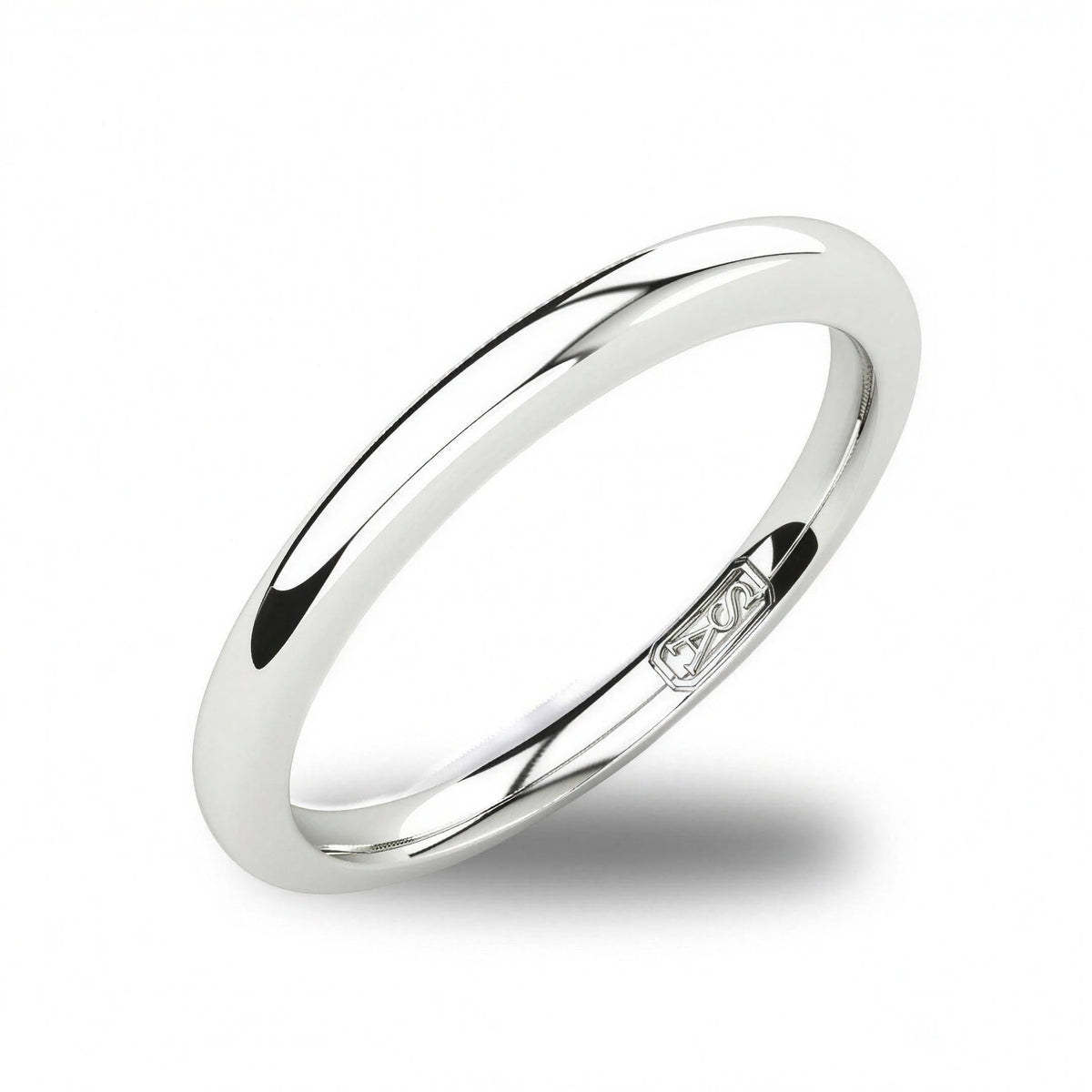
- Round (or "comfort fit"): the outside of the band is curved like a half-circle. This is the most common profile on classic solitaires.
- Flat: the outside of the band is squared off — modern and architectural, often paired with bezel-set diamonds.
- Knife edge: the band rises to a subtle ridge in the middle, catching light like a polished blade.
The simplest rule of thumb: match profile to profile. A round-profile engagement ring pairs effortlessly with a classic round wedding band or a classic half-round wedding band. A flat-profile engagement ring sits beautifully against a classic flat wedding band. A knife-edge engagement ring is best matched with a classic knife edge wedding band — the angles echo each other and the two rings read as a continuous design.
You don't have to match profiles — we make plenty of "intentionally mismatched" pairs — but if you're not sure, matching is the safest, most timeless choice.
Match the metal (or mix it deliberately)
The second decision is metal. The vast majority of the wedding bands we make in our Adelaide boutique are 18kt gold — white, yellow, or rose — in the same alloy used for the engagement ring. There are good reasons for matching:
- Wear rates are similar. Two 18kt bands sitting against each other will wear at roughly the same pace. Mix metals and the softer ring wears faster.
- Colour stays consistent. White gold on white gold reads as one piece; pair white gold with platinum and you'll see a subtle colour mismatch in certain light.
- Repair and resizing is simpler. A jeweller can work on matched metals without colour-mismatched joins.
That said, mixing metals on purpose can be stunning. A rose gold engagement ring with a white gold wedding band is a popular modern look, especially when both rings have a delicate profile. A yellow gold band stacked with a white gold engagement ring nods to the trend of mixing metals across your whole hand — bracelets, watch, earrings — rather than matching everything.
If you do mix, do it intentionally: choose two metals that already appear together elsewhere in your jewellery wardrobe, so the contrast reads as a design choice rather than an oversight.
Get the width right
Width is the dimension brides most often get wrong on a first visit. The instinct is to choose a wedding band the same width as the engagement ring's band — but that often makes the two rings look like a single, heavy stack. A wedding band that's slightly narrower than the engagement ring's shank almost always looks better. It lets the engagement ring stay the visual hero and the wedding band sit as a quiet partner.
Most of our classic wedding bands are made in a 2mm width as standard, which pairs well with the majority of solitaire and halo engagement rings we make. If your engagement ring has a heavier shank — 2.5mm or wider — you can scale up to a 2.5mm or 3mm band without it looking out of balance. If your engagement ring has a very fine shank, a 1.8mm or 2mm band will sit more harmoniously than anything wider.
For men, the conversation is different. Most men's wedding bands sit between 4mm and 6mm wide. Our Mens collection includes wider profiles in classic round, flat, and bevelled finishes that work for hands that wear rings every day in physical jobs.
Plain band or diamond-set?
This is the most personal call. A plain polished band is timeless, low-maintenance, and lets the engagement ring's diamond do all the talking. A diamond-set band adds sparkle along the finger and is particularly striking on the wedding day itself, when photographers will be shooting your hands constantly.
Within diamond-set bands, the setting style matters more than the diamond count:
- Shared claw — diamonds share metal claws between them, giving a continuous line of brilliance with minimal visible metal. A petite shared claw band with eight diamonds is a subtle, elegant choice. Step up to the 20-diamond shared claw band for noticeably more sparkle.
- U-claw set — each diamond sits in a delicate U-shaped basket, exposing more of the diamond from the side. Our petite U-claw band is a quiet way to add light without looking heavy.
- Claw set — each diamond has its own four claws. Slightly more traditional, with crisp definition between stones. The 18-diamond claw set band is a good benchmark style.
If your engagement ring already has diamonds along the shank (a pavé or shared-claw band), choose a wedding band that picks up the same setting style. If your engagement ring is a clean solitaire, you can go either way — many couples choose plain on the wedding day and add a diamond band later as an anniversary gift.
Browse the full range in the wedding bands collection.
Contoured and fitted bands: when your engagement ring needs one
Some engagement rings won't sit flush against a straight wedding band. This is most common with:
- Rings with a low-set or partially recessed centre stone
- Trilogy rings where side stones drop below the main setting
- Vintage-inspired rings with a curved or scalloped underside
- Pear, marquise, or oval rings where the stone tapers down past the band
For these rings we make a fitted or contoured wedding band — cut to nest around the engagement ring so the two sit together as a single line on the finger. A fitted band is bespoke by definition: we either work from your existing engagement ring in the boutique, or take a wax impression to shape the band exactly to its profile.
If your engagement ring was made by us, we can make a contoured band to match the original design without you posting the ring anywhere. If it was made elsewhere, bring the ring in and we'll design around it.
Eternity bands: for the wedding, an anniversary, or both
An eternity band — a ring set with diamonds (or another stone) all the way around the finger — is sometimes worn as a wedding band, sometimes as an anniversary or upgrade gift, and sometimes stacked with both.
Wedding-day eternity bands tend to be slim and continuous, often in a shared-claw or pavé setting. Anniversary eternity bands are usually bolder — larger diamonds, more visible weight on the finger. Our eternity bands collection spans both ends of that spectrum, from a delicate round brilliant shared claw eternity band through to a substantial large claw set eternity band in 1ct total weight.
One practical note on eternity bands: because they're set with diamonds all the way around, they can't be sized in the future the way a plain band can. Make sure you're confident on finger size before commissioning one — or choose a half-eternity (diamonds across the top half only), which can be resized.
Comfort, sizing, and the day-to-day
A wedding band sits on the same finger every day for decades. Two practical things to think about before you choose:
Comfort fit on the inside. All of our wedding bands are made with a slightly domed inside edge, so the ring slips on and off without catching the knuckle. This matters more as your fingers change with age, exercise, pregnancy, or weather.
Your daily activities. If you work with your hands — nursing, trades, gardening, climbing, weights at the gym — talk to us about whether a slimmer profile or a flush-set rather than claw-set band might wear better for you. Diamond claws can be reshaped if they snag, but it's easier to choose a setting that won't snag in the first place.
Sizing. Your ring finger is not the same size in summer and winter, or in the morning and evening. We size to the middle of that range — and if your size ever changes, a complimentary resize is part of the service.
How long does a wedding band take to make?
A classic plain band in a standard size is one of the faster pieces we make. A diamond-set band or a fitted/contoured band takes longer because diamonds need to be selected and set individually, and a fitted band needs to be modelled against your engagement ring. As a guide, allow four to six weeks; diamond-set and fitted designs sit at the longer end.
If you have a wedding date locked in, give yourself a comfortable buffer. We'd rather take the time to get the design right than rush a piece you'll wear for life.
Try before you decide
Pictures only get you so far. A wedding band feels different on the finger than it looks on a screen, and pairing it with your actual engagement ring — on your actual hand — is the only way to know if you've made the right choice.
If you're in Adelaide, book a consultation at our King William Street boutique. Bring your engagement ring (or, if you're the partner planning the proposal, bring a clear photo and an approximate ring size). We'll talk through profile, metal, width, and setting style, try a range of sample bands against your ring, and design something that's genuinely yours — not pulled off a catalogue page.
Book a wedding band consultation or browse the full wedding bands collection to start narrowing things down.